A few days ago, I read Victor Skvortsov's I Switched From VSCode to Zed on Lobsters. It was a neat, short article, not too applicable to me since I don't use Zed very often (I just fall back to it periodically when I can't get nvim LSPs working for a language), but had a decent overview of modern Python language servers.
I was caught a bit off-guard to see this comment below the article, wrote a quick response, and forgot about it while I took a break from online news for a few days.
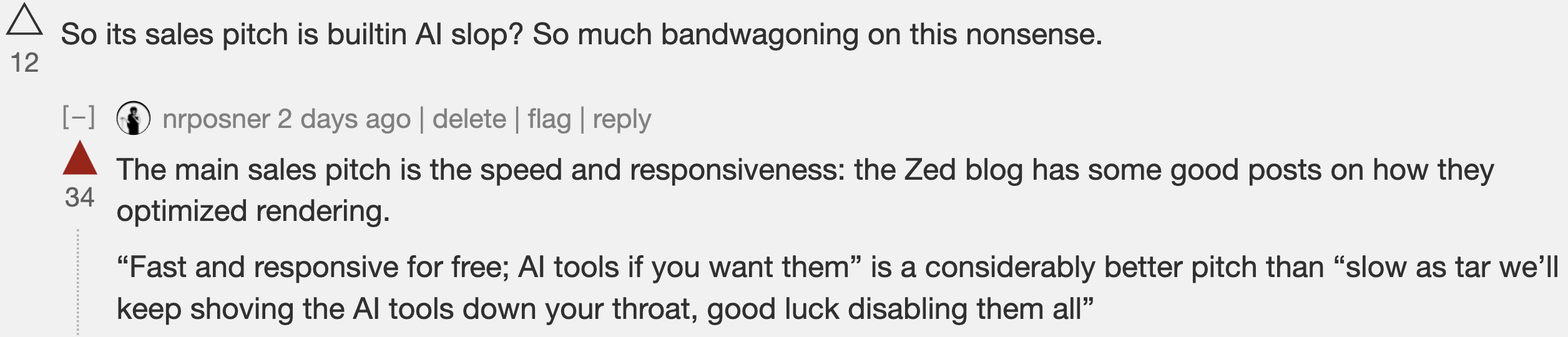
So I was even more surprised to find that it had sparked a lot of discussion and engagement (in extremely relative terms: it's by far my most upvoted comment on the site). It just seemed so odd to me that an extremely mild defense of Zed's AI integration, from someone who doesn't often use Zed or code completion tools, would bring out such a relatively large reaction.
Though on further consideration, it turned out to be a lot less surprising than it first seemed.
The GenAI Backlash, Part Whatever
Just today, I started seeing several prominent members of the Rust community, particularly Rain, Steve Klabnik, and Conrad Ludgate, addressing a shaming/harassment campaign trying to create a list of "Tainted Software" that should not be used, on account of being related to LLM use.
'Related' is doing a lot of the work there. Some of the verboten software listed includes the jujutsu VCS on account of... a contributor on it 'openly' using GenAI on... another unrelated project. And it only gets sillier from there.
Now, I do want to say that I understand where this is coming from emotionally. There's so, so very much to dislike about generative AI technology and its uses.
It's the tool of choice for scams, frauds, bots, and sexual harassment. It has flooded the world with cheap-to-produce slop which anyone trying to use the internet must navigate around, and companies trying to train them have unleashed unspeakably stupid web scrapers which people hosting websites must now account for (often by deliberately trapping them in cheap mazes laced with poison).
It has created a bubble that will almost certainly crash the global economy into yet another recession sometimes in the next two years.
The promise of superintelligences that can cure cancer, once merely remote, are now entirely unbelievable -- not least because of the recent departure of Yann LeCun from Meta, which ended with the 'godfather of AI' blasting his decade-long employer and openly declaring LLM technology a 'dead end' for superintelligence -- thus completing the long-prophesied 'Marcus-LeCun Conjunction event'.
I have no doubt that this technology's net effect over the last five years is overwhelmingly negative, and we'd all be better off if it had never come about.
I can say all of that, and still see that this attempt at a shaming campaign is unspeakably stupid.
As pointed out in the responses to Rain's statement, there's no surer way to sabotage your own boycott than to target free, high-quality software open-source software that people generally love.
These tools aren't being sold for money! If the developers are being compensated for this at all, it's either because they're getting donations from people who are using the tool early on (quite unlikely to change their habits of such a silly list), or because one of the big tech companies that have just spent billions investing in GenAI have decided to toss a couple of gigantic pennies in their direction.
The only plausible effect of this is that the creators of these technologies are harassed, and the coordinators of the campaign burn away their credibility.
And the dumbest part of this is that the targets, many of whom are community tastemakers with noted skepticism of AI, are now less inclined to criticize GenAI.

I think this kind of frustrated backlash is also the source of the above comment: the immediate association of anything LLM-related, even a shell having an integrated MCP server, with AI slop.
Which, to be fair, is a pretty good rule of thumb. If you pick out any given product that touts its integration with 'AI' (and likewise for 'machine learning', 'blockchain', 'quantum *', etc) it's overwhelmingly likely to be ill-considered, low-quality slop -- moreso than if you just picked out any random product, since these hype cycles attract grifters like flies.
Nevertheless, there are some exceptions to the rule -- and others which should be exceptions, but are not.
Zed remains the poster child for good GenAI integration: not because it's especially good (I haven't used it at all), but because it's unobtrusive. When I open it up to tinker with some ReScript code, I don't get unwanted code completion, or popup banners, or prompts to use Copilot. It may as well not be there at all until I specifically call for it.
That matters a great deal to me, and it's driven my tech choices a good deal in the last year. I have a paid subscription to Gemini, and plan to continue paying for it, except in the event that Claude Code turns out to be as good as everyone said and I can ditch in its favor.
But nothing has so personally irked and irritated me more than Google's flailing attempts to integrate Gemini into its suite of digital products.
Searching the internet? Pull up a giant, screen-blocking AI summary I didn't ask for and don't want that slows down and interrupts my search.
Not typing for 5 seconds in a Google Doc? Oh boy, that's the perfect time to prompt me to 'Help me write', as if I were a crayon-eating toddler.
The same in emails and slides. Hell, I can't even turn off Gemini in emails without turning off email sorting, which has nothing at all to do with GenAI!
And mind you, these are features of an AI product that I'm already paying for. Google, you don't have to upsell me, I'm already using it! The difference is that I don't want to see Gemini's ugly sparkly mug unless I specifically ask for it!
Not only are these features worth nothing at all to me, they actively degrade my experience of using the product, and -- as a paying customer, mind -- I either can't turn them off, or lose access to unrelated, preexisting features I do want if I try.
This has motivated me to slowly but surely move off these products: LibreOffice Write, Obsidian, and typst replace my various use cases for Google Docs, LibreOffice Impress replaces Google Slides (though when my audience is technical I'll use presenterm instead), Vivaldi and Kagi instead of Chrome and Google. I'm still figuring out an alternative for GMail, but I've had a great time communicating through other mediums: IRC is pretty neat!
As a rule, any AI integration which:
-
The user has to opt out of instead of opting into
-
The user cannot disable, or cannot disable without breaking unrelated features
is a colossal red flag and anti-recommendation for any product. It's not merely worthless, it's worth negative money.
Zed's option to turn off AI entirely is literally the first header on their Configuration page, their decision to do that is documented in a public blog post, and it's explicitly pointed during onboarding since this past summer.
VSCode's is shunted down at the bottom of their Setup documentation, and was announced, as best as I can tell, deep in some release notes.
These are two products with very different priorities.
When Zed's blog says "Our goal at Zed has always been to build the world’s best code editor." I believe them. I don't know if they'll succeed, and don't think their offering is right for me, but I believe they are actually striving towards that goal as best they can.
Microsoft is not doing the same with VSCode, or any of their products really. It's mediocrity upon mediocrity with them, just good enough to be tolerable, if that, with no instinct for excellence.
Beyond the degradation of UX, there's another downside which the leadership at these companies seem totally ignorant of.
So much of corporate branding and PR strives to give people the impression of the company as a person. Of course, companies are not people, except in a narrow legal sense, but there are considerable benefits to maintaining this illusion.
When you push AI onto your users like this, I feel very strongly that the company is a person, and they communicate a very particular emotion: neediness.
No matter what a person's other qualities, nothing makes them annoy and grate more quickly than neediness.
'You like my AI tools, right? You'll use them, right? I spent so much money on them, you have to like them please please please-'
God above, shut up. Have some self-respect.
This, too, comes on the tails of Micro~~slop~~soft CEO Satya Nadella's much beclowned 'Looking Ahead to 2026' post, whose title everyone has now mentally changed to 'Please Stop Calling it Slop'.
I can't say I know much about the CEO of Microsoft, but who could have known he was such a terrible writer? Speaking of GenAI tools as 'bicycles for the mind' and begging his customers to 'get beyond the arguments of slop vs sophistication', he manages to spew out such gobbledygook as "develop a new equilibrium in terms of our ‘theory of the mind’ that accounts for humans being equipped with these new cognitive amplifier tools as we relate to each other."
A cognitive amplifier? Is that what you think these tools are? Because my experience using them myself, and seeing others use them, is that unless they're used carefully by people who know what they're doing, they make their users stupider, lazier, and more ignorant.
Microsoft has been the company of slop incarnate since well before the release of ChatGPT: its dominance has nothing to do with the quality of its software, and everything to do with its sales department and bundling tools for corporate accounts. Their desktop OS is slop. Their office apps are slop. Microsoft Teams is... god above, how can one even begin to describe Microsoft Teams? And I've only heard vague rumors of what Azure DataFactory does to the companies that buy it, but good lord is that an anti-recommendation.
Maybe, just maybe, if Satya doesn't want AI to be associated with slop, they could start by making a non-AI product that people actually like using, instead of just being shackled to it by company policy and. Hell, they could start with something small but impactful, like a text editor.
Hey, Satya, have you heard of this thing called Zed? Those guys might be able to give you a helping hand.